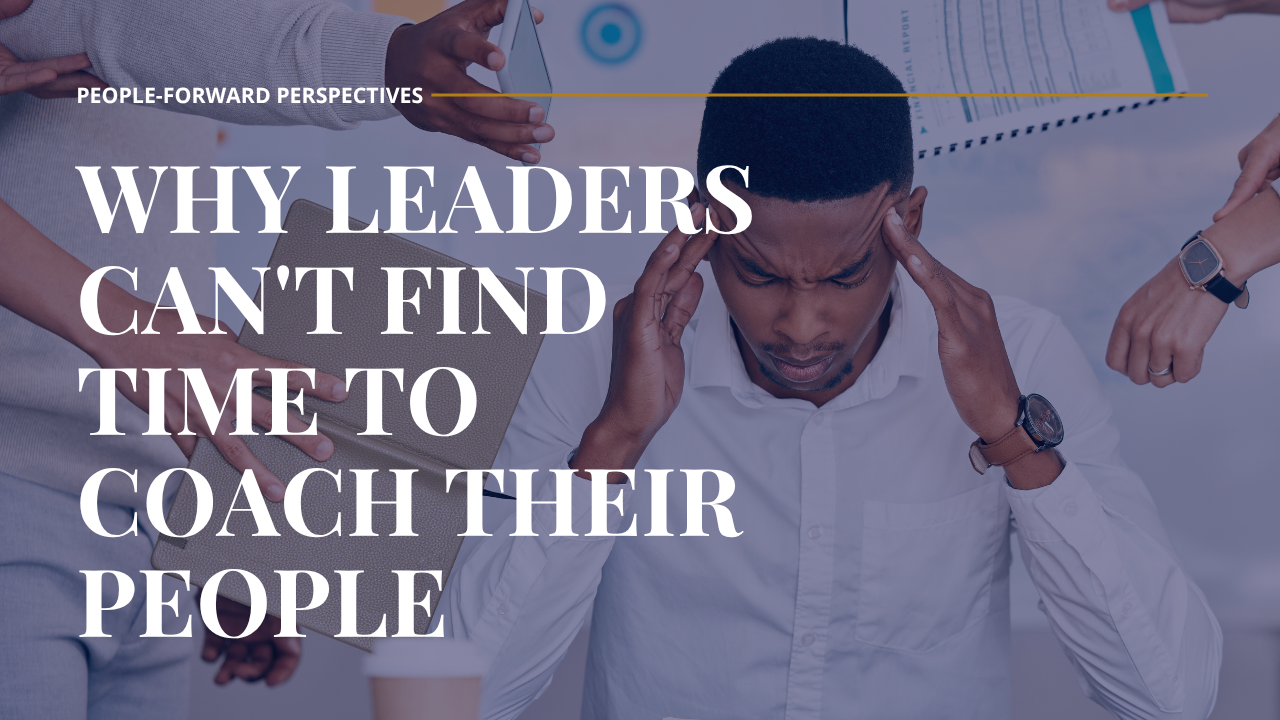
Why Leaders Can't Find Time to Coach Their People
Over the last six years or so, I've watched a steady trend of leaders finding less and less time to really lean into coaching and developing their people. It started as a rallying cry of middle managers who felt squeezed between the demands of achieving organizational results and supporting their staff's needs. Then, as organizations have continually shifted and downsized over the years, and as generational changes reshape the way we work, leaders at every level are now feeling increasingly stretched.
They know they should be developing and coaching their people, and they want to, but they don't have the time. Some of it can be attributed to discipline, interest, or time management, but most of it comes down to capacity. There simply isn't room within the role, as it's structured, to add coaching to their plate successfully.
So if you've been in that same boat, feeling the same strain or maybe even a little guilt along with it, here are a few new ways to think about the problem, and a few new ways to approach it.
The short version: most leaders can't coach and develop their people, not because they lack the skill or the will, but because the role leaves no capacity for it. The fix is structural, not personal.
What's really going on
The reason you can't develop your people usually isn't a lack of willpower. It's math.
You're carrying a full portfolio of your own deliverables, and what's left of your week gets eaten by meetings, planning, and goal-setting. The "people" work, the actual coaching and development, get whatever scraps remain, which is usually nothing.
And this isn't just a story leaders tell themselves. McKinsey surveyed 706 middle managers and found that they spend almost three-quarters of their time on work unrelated to developing their people. Yet when those same managers were asked where they add the most value, 86% said coaching their people. You know it's the highest-value thing you do, but the structure of your job makes it nearly impossible.
That's why "how do I become a better coach?" is not the question to ask, because it puts all the weight on you and none on the structure around you. The better question, the one that actually opens up the possibility for change, is "where has the design of my role made it nearly impossible to lead the people I'm responsible for?"
That's the question you can not only answer, but also do something about.
Start with your own calendar
We've already established that you can't coach someone when the job doesn't give you time to do it, so the first thing you have to do is take something off. You can start by reducing the number of standing meetings, lightening your individual portfolio, or handing off some of your administrative load. Or pushing to lead a smaller team so you can actually invest in the people on it. I know the instinct is to just try to fit it in, but if you build a coaching habit before you've cleared space for it, the first busy week you encounter, it will be back to business as usual. Make the room first. Borrowing from a famous phrase, "If you build it (capacity), they will come (and you can coach)."
Make coaching a routine, not a rescue mission
Coaching can't wait for things to calm down, because, let's be honest, they never will. It has to be built into how you already operate, rather than left to your spare time. That means putting it on a real cadence, short, regular check-ins that live on the calendar, and letting your people own their own development plans while you guide the scope and direction of the plan by asking good questions. That last part matters more than it sounds. It moves the heavy lifting to the person who's growing rather than to you. When you build it that way, coaching can survive even the most tumultuous week, because it's not fully and exclusively dependent on you heroically finding time you don't have. It becomes a partnership in which you find capacity, and they bring the plan.
Count the people who work, or it disappears
Most organizations ask you to manage your people, but it's vague on coaching and development. Moreover, those activities aren't measured or rewarded when done well. As a result, what doesn't get measured gets missed, or quietly vanishes. What gets measured, however, does get managed, and coaching should be treated as a priority. So of course, you pour your hours into individual and strategic work because that's what gets seen and rewarded, while developing your people feels more like an afterthought. If it matters, it has to show up in how you're evaluated, whether your people are getting promoted, whether your bench is deepening, and whether your direct reports are taking on real decisions. What gets measured gets the time. Admittedly, this one requires an organizational fix, but you can advocate for it. If coaching becomes paramount within your role, it would help in restructuring your role to ensure you have the time and resources needed to do it effectively.
Where AI fits
Use it. We are in the age of the agentic organization. If time is your constraint, AI can hand you some back. It can help you prep for a coaching conversation, think through the right questions, or work out how to frame feedback that's hard to give.
But know where it stops. AI gives you a one-size-fits-all answer. You give your people a one-size-fits-one answer. You know who needs you to be involved early on projects and who needs you to give them room to run, who hears a stretch assignment as an invitation and who hears it as a threat. That nuance came from the relationship you build with your people, and AI can't do that. Yes, let the tool carry the prep work, but continue to carry and hone your discernment.
The one thing worth holding onto
Capacity isn't found. It's built on purpose by you and the organization around you. And your people can carry far more than you think. Part of their development should be for them to articulate what they want, need, and ways in which they want to grow in their role or for their next. The only challenge you'll need to overcome is building the conditions to make all of this a reality.
That's the work we do with leaders and organizations at ThriveAxis®. If the strain here sounds familiar, let's talk.
I've written about this more extensively in my latest LinkedIn newsletter. You can read it here, and be sure to subscribe so it lands in your inbox every month.
----
This article was written by Dr. Carol Parker Walsh, JD, PhD, an award-winning executive coach, organizational strategist, and founder of ThriveAxis®, a leadership development firm that helps organizations cultivate People-Forward Leaders™ and high-performing teams.
A CNBC Leadership Expert and contributor to Forbes, Newsweek, and Entrepreneur, Dr. Parker Walsh has been featured on LinkedIn Learning, ABC, CBS, Fast Company, and Fortune. She's a Fellow with the Harvard Institute of Coaching, and her thought leadership has reached more than 100,000 professionals worldwide.
A nationally recognized keynote speaker, TEDx presenter, and four-time Brandon Hall Group HCM Excellence Award recipient and Webby Honoree Award winner for her thought leadership, she empowers leaders and organizations to thrive amid disruption by building trust, alignment, and adaptive cultures that drive performance and retention.